
Advertisement
-
Published Date
October 8, 2025This ad was originally published on this date and may contain an offer that is no longer valid. To learn more about this business and its most recent offers, click here.
Ad Text
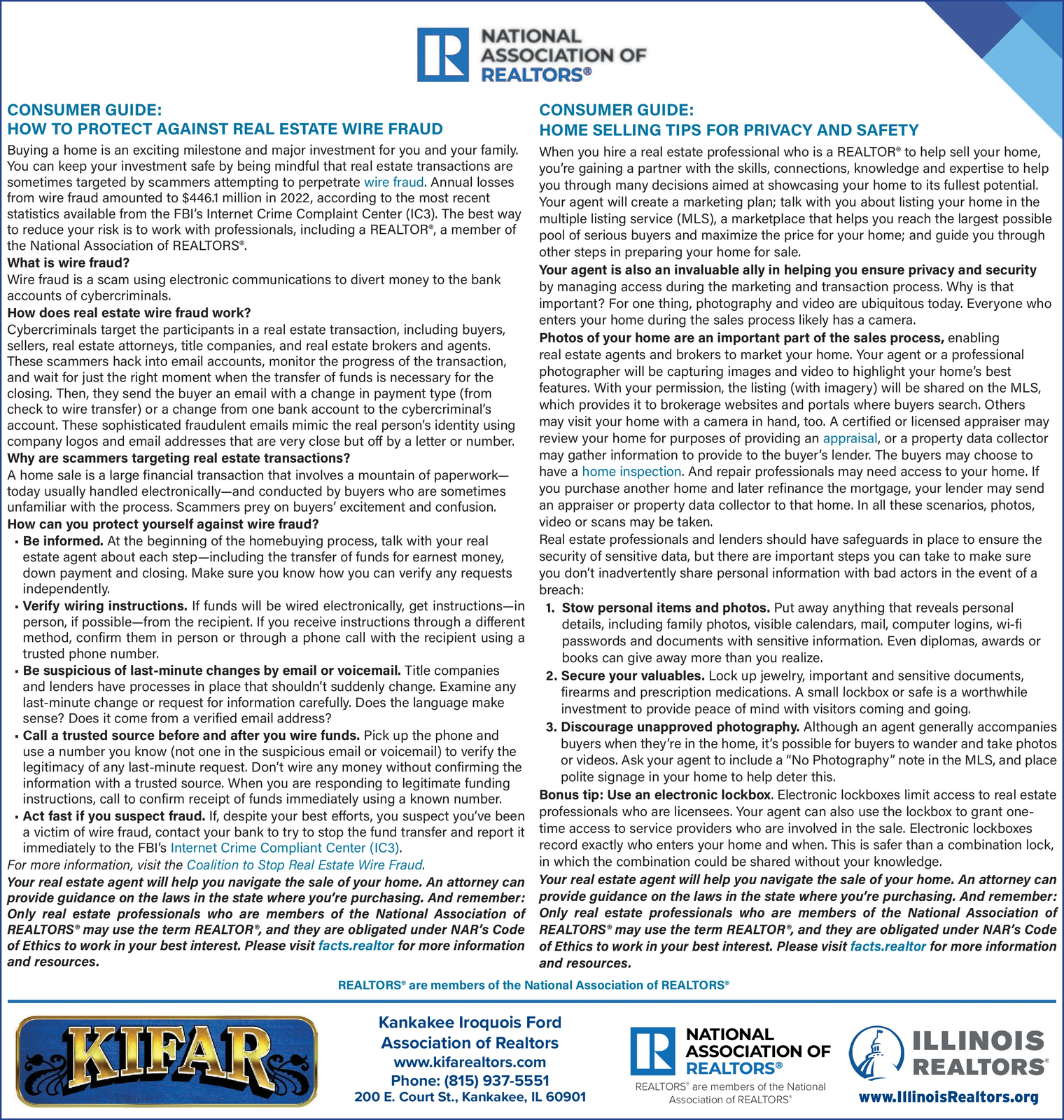
CONSUMER GUIDE: R NATIONAL ASSOCIATION OF REALTORS® HOW TO PROTECT AGAINST REAL ESTATE WIRE FRAUD Buying a home is an exciting milestone and major investment for you and your family. You can keep your investment safe by being mindful that real estate transactions are sometimes targeted by scammers attempting to perpetrate wire fraud. Annual losses from wire fraud amounted to $446.1 million in 2022, according to the most recent statistics available from the FBI's Internet Crime Complaint Center (IC3). The best way to reduce your risk is to work with professionals, including a REALTOR®, a member of the National Association of REALTORS®. What is wire fraud? Wire fraud is a scam using electronic communications to divert money to the bank accounts of cybercriminals. How does real estate wire fraud work? Cybercriminals target the participants in a real estate transaction, including buyers, sellers, real estate attorneys, title companies, and real estate brokers and agents. These scammers hack into email accounts, monitor the progress of the transaction, and wait for just the right moment when the transfer of funds is necessary for the closing. Then, they send the buyer an email with a change in payment type (from check to wire transfer) or a change from one bank account to the cybercriminal's account. These sophisticated fraudulent emails mimic the real person's identity using company logos and email addresses that are very close but off by a letter or number. Why are scammers targeting real estate transactions? A home sale is a large financial transaction that involves a mountain of paperwork- today usually handled electronically-and conducted by buyers who are sometimes unfamiliar with the process. Scammers prey on buyers' excitement and confusion. How can you protect yourself against wire fraud? . Be informed. At the beginning of the homebuying process, talk with your real estate agent about each step-including the transfer of funds for earnest money, down payment and closing. Make sure you know how you can verify any requests independently. . Verify wiring instructions. If funds will be wired electronically, get instructions-in person, if possible-from the recipient. If you receive instructions through a different method, confirm them in person or through a phone call with the recipient using a trusted phone number. . Be suspicious of last-minute changes by email or voicemail. Title companies and lenders have processes in place that shouldn't suddenly change. Examine any last-minute change or request for information carefully. Does the language make sense? Does it come from a verified email address? . Call a trusted source before and after you wire funds. Pick up the phone and use a number you know (not one in the suspicious email or voicemail) to verify the legitimacy of any last-minute request. Don't wire any money without confirming the information with a trusted source. When you are responding to legitimate funding instructions, call to confirm receipt of funds immediately using a known number. Act fast if you suspect fraud. If, despite your best efforts, you suspect you've been a victim of wire fraud, contact your bank to try to stop the fund transfer and report it immediately to the FBI's Internet Crime Compliant Center (IC3). For more information, visit the Coalition to Stop Real Estate Wire Fraud. Your real estate agent will help you navigate the sale of your home. An attorney can provide guidance on the laws in the state where you're purchasing. And remember: Only real estate professionals who are members of the National Association of REALTORS® may use the term REALTOR®, and they are obligated under NAR's Code of Ethics to work in your best interest. Please visit facts.realtor for more information and resources. KIFAR CONSUMER GUIDE: HOME SELLING TIPS FOR PRIVACY AND SAFETY When you hire a real estate professional who is a REALTOR® to help sell your home, you're gaining a partner with the skills, connections, knowledge and expertise to help you through many decisions aimed at showcasing your home to its fullest potential. Your agent will create a marketing plan; talk with you about listing your home in the multiple listing service (MLS), a marketplace that helps you reach the largest possible pool of serious buyers and maximize the price for your home; and guide you through other steps in preparing your home for sale. Your agent is also an invaluable ally in helping you ensure privacy and security by managing access during the marketing and transaction process. Why is that important? For one thing, photography and video are ubiquitous today. Everyone who enters your home during the sales process likely has a camera. Photos of your home are an important part of the sales process, enabling real estate agents and brokers to market your home. Your agent or a professional photographer will be capturing images and video to highlight your home's best features. With your permission, the listing (with imagery) will be shared on the MLS, which provides it to brokerage websites and portals where buyers search. Others may visit your home with a camera in hand, too. A certified or licensed appraiser may review your home for purposes of providing an appraisal, or a property data collector may gather information to provide to the buyer's lender. The buyers may choose to have a home inspection. And repair professionals may need access to your home. If you purchase another home and later refinance the mortgage, your lender may send an appraiser or property data collector to that home. In all these scenarios, photos, video or scans may be taken. Real estate professionals and lenders should have safeguards in place to ensure the security of sensitive data, but there are important steps you can take to make sure you don't inadvertently share personal information with bad actors in the event of a breach: 1. Stow personal items and photos. Put away anything that reveals personal details, including family photos, visible calendars, mail, computer logins, wi-fi passwords and documents with sensitive information. Even diplomas, awards or books can give away more than you realize. 2. Secure your valuables. Lock up jewelry, important and sensitive documents, firearms and prescription medications. A small lockbox or safe is a worthwhile investment to provide peace of mind with visitors coming and going. 3. Discourage unapproved photography. Although an agent generally accompanies buyers when they're in the home, it's possible for buyers to wander and take photos or videos. Ask your agent to include a "No Photography" note in the MLS, and place polite signage in your home to help deter this. Bonus tip: Use an electronic lockbox. Electronic lockboxes limit access to real estate professionals who are licensees. Your agent can also use the lockbox to grant one- time access to service providers who are involved in the sale. Electronic lockboxes record exactly who enters your home and when. This is safer than a combination lock, in which the combination could be shared without your knowledge. Your real estate agent will help you navigate the sale of your home. An attorney can provide guidance on the laws in the state where you're purchasing. And remember: Only real estate professionals who are members of the National Association of REALTORS® may use the term REALTOR®, and they are obligated under NAR's Code of Ethics to work in your best interest. Please visit facts.realtor for more information and resources. REALTORS® are members of the National Association of REALTORS® Kankakee Iroquois Ford Association of Realtors www.kifarealtors.com Phone: (815) 937-5551 200 E. Court St., Kankakee, IL 60901 R NATIONAL ASSOCIATION OF REALTORS® REALTORS® are members of the National Association of REALTORS® ILLINOIS REALTORS® www.IllinoisRealtors.org CONSUMER GUIDE : R NATIONAL ASSOCIATION OF REALTORS® HOW TO PROTECT AGAINST REAL ESTATE WIRE FRAUD Buying a home is an exciting milestone and major investment for you and your family . You can keep your investment safe by being mindful that real estate transactions are sometimes targeted by scammers attempting to perpetrate wire fraud . Annual losses from wire fraud amounted to $ 446.1 million in 2022 , according to the most recent statistics available from the FBI's Internet Crime Complaint Center ( IC3 ) . The best way to reduce your risk is to work with professionals , including a REALTOR® , a member of the National Association of REALTORS® . What is wire fraud ? Wire fraud is a scam using electronic communications to divert money to the bank accounts of cybercriminals . How does real estate wire fraud work ? Cybercriminals target the participants in a real estate transaction , including buyers , sellers , real estate attorneys , title companies , and real estate brokers and agents . These scammers hack into email accounts , monitor the progress of the transaction , and wait for just the right moment when the transfer of funds is necessary for the closing . Then , they send the buyer an email with a change in payment type ( from check to wire transfer ) or a change from one bank account to the cybercriminal's account . These sophisticated fraudulent emails mimic the real person's identity using company logos and email addresses that are very close but off by a letter or number . Why are scammers targeting real estate transactions ? A home sale is a large financial transaction that involves a mountain of paperwork- today usually handled electronically - and conducted by buyers who are sometimes unfamiliar with the process . Scammers prey on buyers ' excitement and confusion . How can you protect yourself against wire fraud ? . Be informed . At the beginning of the homebuying process , talk with your real estate agent about each step - including the transfer of funds for earnest money , down payment and closing . Make sure you know how you can verify any requests independently . . Verify wiring instructions . If funds will be wired electronically , get instructions - in person , if possible - from the recipient . If you receive instructions through a different method , confirm them in person or through a phone call with the recipient using a trusted phone number . . Be suspicious of last - minute changes by email or voicemail . Title companies and lenders have processes in place that shouldn't suddenly change . Examine any last - minute change or request for information carefully . Does the language make sense ? Does it come from a verified email address ? . Call a trusted source before and after you wire funds . Pick up the phone and use a number you know ( not one in the suspicious email or voicemail ) to verify the legitimacy of any last - minute request . Don't wire any money without confirming the information with a trusted source . When you are responding to legitimate funding instructions , call to confirm receipt of funds immediately using a known number . Act fast if you suspect fraud . If , despite your best efforts , you suspect you've been a victim of wire fraud , contact your bank to try to stop the fund transfer and report it immediately to the FBI's Internet Crime Compliant Center ( IC3 ) . For more information , visit the Coalition to Stop Real Estate Wire Fraud . Your real estate agent will help you navigate the sale of your home . An attorney can provide guidance on the laws in the state where you're purchasing . And remember : Only real estate professionals who are members of the National Association of REALTORS® may use the term REALTOR® , and they are obligated under NAR's Code of Ethics to work in your best interest . Please visit facts.realtor for more information and resources . KIFAR CONSUMER GUIDE : HOME SELLING TIPS FOR PRIVACY AND SAFETY When you hire a real estate professional who is a REALTOR® to help sell your home , you're gaining a partner with the skills , connections , knowledge and expertise to help you through many decisions aimed at showcasing your home to its fullest potential . Your agent will create a marketing plan ; talk with you about listing your home in the multiple listing service ( MLS ) , a marketplace that helps you reach the largest possible pool of serious buyers and maximize the price for your home ; and guide you through other steps in preparing your home for sale . Your agent is also an invaluable ally in helping you ensure privacy and security by managing access during the marketing and transaction process . Why is that important ? For one thing , photography and video are ubiquitous today . Everyone who enters your home during the sales process likely has a camera . Photos of your home are an important part of the sales process , enabling real estate agents and brokers to market your home . Your agent or a professional photographer will be capturing images and video to highlight your home's best features . With your permission , the listing ( with imagery ) will be shared on the MLS , which provides it to brokerage websites and portals where buyers search . Others may visit your home with a camera in hand , too . A certified or licensed appraiser may review your home for purposes of providing an appraisal , or a property data collector may gather information to provide to the buyer's lender . The buyers may choose to have a home inspection . And repair professionals may need access to your home . If you purchase another home and later refinance the mortgage , your lender may send an appraiser or property data collector to that home . In all these scenarios , photos , video or scans may be taken . Real estate professionals and lenders should have safeguards in place to ensure the security of sensitive data , but there are important steps you can take to make sure you don't inadvertently share personal information with bad actors in the event of a breach : 1. Stow personal items and photos . Put away anything that reveals personal details , including family photos , visible calendars , mail , computer logins , wi - fi passwords and documents with sensitive information . Even diplomas , awards or books can give away more than you realize . 2. Secure your valuables . Lock up jewelry , important and sensitive documents , firearms and prescription medications . A small lockbox or safe is a worthwhile investment to provide peace of mind with visitors coming and going . 3. Discourage unapproved photography . Although an agent generally accompanies buyers when they're in the home , it's possible for buyers to wander and take photos or videos . Ask your agent to include a " No Photography " note in the MLS , and place polite signage in your home to help deter this . Bonus tip : Use an electronic lockbox . Electronic lockboxes limit access to real estate professionals who are licensees . Your agent can also use the lockbox to grant one- time access to service providers who are involved in the sale . Electronic lockboxes record exactly who enters your home and when . This is safer than a combination lock , in which the combination could be shared without your knowledge . Your real estate agent will help you navigate the sale of your home . An attorney can provide guidance on the laws in the state where you're purchasing . And remember : Only real estate professionals who are members of the National Association of REALTORS® may use the term REALTOR® , and they are obligated under NAR's Code of Ethics to work in your best interest . Please visit facts.realtor for more information and resources . REALTORS® are members of the National Association of REALTORS® Kankakee Iroquois Ford Association of Realtors www.kifarealtors.com Phone : ( 815 ) 937-5551 200 E. Court St. , Kankakee , IL 60901 R NATIONAL ASSOCIATION OF REALTORS® REALTORS® are members of the National Association of REALTORS® ILLINOIS REALTORS® www.IllinoisRealtors.org